Plants & Seeds: Difference between revisions
No edit summary |
|||
| Line 80: | Line 80: | ||
Often this table is presented in L-shaped manner: | Often this table is presented in L-shaped manner: | ||
{| class="wikitable" border="5" style="text-align: center; | |||
| [[File:Campion_Flowers.png]] | |||
| [[File:Poppies.png]] | |||
| [[File:Snowdrops1.png]] | |||
| [[File:Bulrushes.png]] | |||
| [[File:Lillies.png]] | |||
| [[File:Pampas_Grass.png]] | |||
| [[File:Rushes.png]] | |||
| [[File:Elephant_Ear_Plant.png]] | |||
| [[File:Fern.png]] | |||
|- | |||
| [[File:Poppies.png]] | |||
| [[File:Snowdrops1.png]] | |||
| [[File:Bulrushes.png]] | |||
| [[File:Lillies.png]] | |||
| [[File:Pampas_Grass.png]] | |||
| [[File:Rushes.png]] | |||
| [[File:Elephant_Ear_Plant.png]] | |||
| [[File:Fern.png]] | |||
| [[File:Ponytail_Palm.png]] | |||
|- | |||
| [[File:Snowdrops1.png]] | |||
| [[File:Bulrushes.png]] | |||
| [[File:Lillies.png]] | |||
| [[File:Pampas_Grass.png]] | |||
| [[File:Rushes.png]] | |||
| [[File:Elephant_Ear_Plant.png]] | |||
| [[File:Fern.png]] | |||
| [[File:Ponytail_Palm.png]] | |||
| [[File:Small_Palm.png]] | |||
|- | |||
| [[File:Bulrushes.png]] | |||
| [[File:Lillies.png]] | |||
| [[File:Pampas_Grass.png]] | |||
| [[File:Rushes.png]] | |||
| [[File:Elephant_Ear_Plant.png]] | |||
| [[File:Fern.png]] | |||
| [[File:Ponytail_Palm.png]] | |||
| [[File:Small_Palm.png]] | |||
| [[File:Century_Plant.png]] | |||
|- | |||
| [[File:Lillies.png]] | |||
| [[File:Pampas_Grass.png]] | |||
| [[File:Rushes.png]] | |||
| [[File:Elephant_Ear_Plant.png]] | |||
| [[File:Fern.png]] | |||
| [[File:Ponytail_Palm.png]] | |||
| [[File:Small_Palm.png]] | |||
| [[File:Century_Plant.png]] | |||
| [[File:Water_Plant.png]] | |||
|- | |||
| [[File:Pampas_Grass.png]] | |||
| [[File:Rushes.png]] | |||
| [[File:Elephant_Ear_Plant.png]] | |||
| [[File:Fern.png]] | |||
| [[File:Ponytail_Palm.png]] | |||
| [[File:Small_Palm.png]] | |||
| [[File:Century_Plant.png]] | |||
| [[File:Water_Plant.png]] | |||
| [[File:Snake_Plant.png]] | |||
|- | |||
| [[File:Rushes.png]] | |||
| [[File:Elephant_Ear_Plant.png]] | |||
| [[File:Fern.png]] | |||
| [[File:Ponytail_Palm.png]] | |||
| [[File:Small_Palm.png]] | |||
| [[File:Century_Plant.png]] | |||
| [[File:Water_Plant.png]] | |||
| [[File:Snake_Plant.png]] | |||
| [[File:Orfluer_Flowers.png]] | |||
|- | |||
| [[File:Elephant_Ear_Plant.png]] | |||
| [[File:Fern.png]] | |||
| [[File:Ponytail_Palm.png]] | |||
| [[File:Small_Palm.png]] | |||
| [[File:Century_Plant.png]] | |||
| [[File:Water_Plant.png]] | |||
| [[File:Snake_Plant.png]] | |||
| [[File:Orfluer_Flowers.png]] | |||
| [[File:Juniper_Bush.png]] | |||
|- | |||
| [[File:Fern.png]] | |||
| [[File:Ponytail_Palm.png]] | |||
| [[File:Small_Palm.png]] | |||
| [[File:Century_Plant.png]] | |||
| [[File:Water_Plant.png]] | |||
| [[File:Snake_Plant.png]] | |||
| [[File:Orfluer_Flowers.png]] | |||
| [[File:Juniper_Bush.png]] | |||
| [[File:Foxglove_Flowers.png]] | |||
|} | |||
[[File:Cross.jpg]] | [[File:Cross.jpg]] | ||
Revision as of 21:30, 15 November 2025

Seeds are small items that can be used for growing Plants via Gardening. They each weigh one stone and can be stacked.
There are two factors that determine a plant: variety and color. Varieties are then grouped into roughly 4 classes: classical, bonsai, peculiar and fragrant and oddities.
Seeds with particular color and varieties are initially gained as loot from certain creatures, but most varieties and colors are grown by breeding multiple generations of plants.
Certain older or bugged seeds that do not stack can be made stackable with use of the Gardener's Toolbox.
Classical Breedable Plants
Certain creatures drop Plain, Red, Blue or Yellow seeds. In early times, seeds obtained via combat used to produce plants of one of three varieties:
 Ferns
Ferns Campion Flowers
 Foxglove Flowers
Currently tribarrel cacti seeds are replaced by random seeds, which now include all classical varieties as well as (flowery) cactus oddity and vanilla oddity. However, two thirds of seed drops are still either campion flowers or ferns.
Such seeds will be named according to their color (eg "Red Seed"). There are several ways to obtain descriptive seeds (eg "Red Tribarrel Cactus Seed"):
- If a plant is grown and then bred with itself, it will produce descriptive seeds of the same type.
- If a seed is dropped into a seed box. its variety is automatically identified.
- Poppies dust can be used to identify the variety of a seed as well.
Breeding different combinations of these seeds together can produce more colors and plant varieties. Any plant that provides seeds can produce a total of eight over it's lifetime.
The initial starting seeds are dropped by:
Breeding Table
There are 17 types of classical breedable varieties:

|

|

|

|

|

|

|

|

|

|

|

|

|

|

|

|

|
| Campions Flowers |
Poppies | Snowdrop | Bulrushes | Lillies | Pampas Grass | Rushes | Elephant Ear Plant |
Fern | Ponytail Palm | Small Palm | Century Plant | Water Plant | Snake Plant | Orfluer Flowers |
Junpier Bush |
Foxglove Flowers |
This order of appearance is useful for identifying the breed of the next generation. If you breed two plants of varieties in this table, the next generation will be the variety of the middle one.
- Example 1. If you cross-pollinate campion flowers and fern, the middle one between these two varieties is
 lilly
lilly - Example 2. If you cross-pollinate
 elephant ear plant and
  water plant, there is no exact middle one because there are even number of varieties inbetween. In this case, the next generation will be either
  ponytail palm or
  small palm, equally likely.
Often this table is presented in L-shaped manner:
|
|
|
|
|
|
|
|
|
|
|
|
|
|
|
|
|
|
|
|
|
|
|
|
|
|
|
|
|
|
|
|
|
|
|
|
|
|
|
|
|
|
|
|
|
|
|
|
|
|
|
|
|
|
|
|
|
|
|
|
|
|
|
|
|
|
|
|
|
|
|
|
|
|
|
|
|
|
|
|
|
|
|
|
|
|
|
|
|
|

Resource Growing Plants
Some plants produce resources which can be harvested via the Plant Resource GUMP. Up to eight units can be harvested from any given plant.
Green Thorns, which produce various random effects, are produced by Bright Green plants of these types:
 Snake Plants
- File:Barrel Cactus.png Barrel Cacti

Red Leaves, which lock the contents of books, are produced by Bright Red plants of these types:
- Ponytail Palms
- Elephant Ear Plants
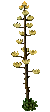 Century Plants
Orange Petals, which provide high levels of poison resistance, are produced by Bright Orange plants of these types:
 Pampas Grasses
 Poppies
 Bulrushes
Poppies Dust, which is used to ID unnamed seeds, is produced by the "peculiar" style of poppies.
Flax Flowers produce bales of cotton and the cypress trees produce bark fragments.
Mutant Plants
Mutants are grown from specially colored seeds, but cannot be bred and do not produce more. There are 2 ways of obtaining mutant seeds.
1st Way. They are typically obtained by completing the Naturalist Quest.
- If you investigate 4 egg nests, they come in aqua, pink and magenta. If you also complete investigation of the secret egg nests, they come in black, white and fire red.
- Aqua, pink, magenta and fire seeds always come in classical breedable variety, (flowery) cactus oddity and vanilla oddity.
- Black and white seeds always come in peculiar varieties.
2nd Way. Any plant that can produce seeds (aside from the Cocoa Tree) also has a chance of producing black or white mutants instead of the color they normally would. Such seeds are very rare.
Bonsai Plants
See Also
{{#fornumargs: key | value | [[Category:{{#var: value}}|Plants & Seeds]] }}